
Our ears are not only organs that help us hear. They also are the centre of our sense of balance. So what happens when this delicate and complex system becomes ill? Hearing disorders can be as simple as earwax or as life-changing as neurological conditions. In this article we will consider the main diseases threatening our ears, their symptoms and modern methods of treatment.
Ear structure and disease mapping
The ear is divided into three main regions, each with its own specific diseases:
Diseases of the outer ear:
The auricle and the ear canal are involved. The most common is swimmer’s ear, or otitis externa, an infection of the outer ear canal. This is caused by the growth of bacteria or fungi in moist conditions. Excessive ear wax (cerumen) is also one of the most common ailments in this area.
Middle ear diseases:
Eardrum and the air-filled cavity (ossicles) behind it. Otitis media, or middle ear infection, is especially common in children. The Eustachian tube is blocked, and fluid builds up, and an infection develops. Otosclerosis is an abnormal hardening of the ossicles of the middle ear (especially the stapes) causing loss of movement. It may be hereditary.
Inner ear (cochlea and nerves) diseases:
This is where sound is converted into an electrical signal and sent to the brain. This is where sensorineural hearing loss occurs. Meniere’s disease is a chronic condition that causes dizziness, tinnitus and fluctuating hearing loss due to a sudden increase of fluid pressure in the inner ear. An acoustic neuroma, however, is a benign tumour that grows on the auditory and vestibular nerves.
Balance is endangered, not only hearing
The semicircular canals in the ear (vestibular system) are the balance board of our body. This can make the person feel off-balance, dizzy (vertigo), and nauseous all of the time. Benign Paroxysmal Positional Vertigo (BPPV) is the most common balance disorder, caused by the displacement of calcium crystals (otoliths) in the inner ear and can be treated by simple manoeuvres.
Hidden signs of hearing problems
Hearing disorders are not just about “not being able to hear”. Here are the signals you should be watching for:
- Tinnitus (ringing): The person hears whistling, buzzing or hissing sounds in the ear when there is no external sound. This is a common accompaniment of most hearing disorders.
- Vertigo (Dizziness): A sensation that the room is spinning around you. This is a large indicator of pressure changes in the fluid of the inner ear.
- Difficulty understanding speech: You can hear the sound, but you cannot make out the words. This is especially true in the case of problems involving the inner ear or auditory nerve.
- Ear pressure: Feeling of fullness in the ear, such as you might feel when an aeroplane is landing. It can be more than just a blockage; it can be something serious like Meniere’s disease.
What is hearing loss?
Simply put, hearing loss is the partial or complete loss of our ability to hear sounds. There are three main parts to our ear. The outer ear, the middle ear and the inner ear. Hearing loss can be broadly categorised into three main types, based on where the problem occurs in the ear:
Hearing loss, conductive
This type is caused by a problem with the transmission of sound waves from the outer or middle ear to the inner ear. Causes include ear blockage by wax, perforated eardrum, middle ear infections or problems with the movement of the ossicles (bones) in the middle ear. It is usually correctable by medical or surgical treatment.
Sensorineural hearing loss:
This is the most common type. This occurs due to damage to the sensitive hair cells in the inner ear (cochlea) or the auditory nerve. The loss can be caused by ageing, prolonged exposure to loud sounds, certain medications and genetic factors. This kind of hearing loss is unfortunately permanent in most cases.
Mixed hearing loss:
Mixed hearing loss is a combination of conductive and sensorineural hearing loss.
Degree of hearing loss
The specialist determines the degree of hearing loss based on the results of the hearing test (audiometry). These degrees are measured in decibels (dB). Decibels tell a person how loud sounds are to hear.
- Normal hearing (0-20 dB): Very faint sounds like a whisper are heard easily.
- Mild hearing loss (26-40 dB): Problems occur, especially in noisy environments or when the speaker is using a quiet voice. For example, you may not hear high-pitched sounds like “s”, “f”, and “t”.
- Moderate Hearing Loss (41-55 dB): You will notice it is difficult to follow a normal conversation. The volume of the TV or radio is always turned down.
- Moderate to severe hearing loss (56-70 dB): You cannot hear normal speech sounds. And communication becomes almost impossible.
- Severe hearing loss (71-90 dB): Loud sounds (e.g., a car horn) are heard. Communication on a daily basis is seriously affected.
- Profound hearing loss (91 dB and above): The person is not able to hear even very loud sounds; he can only feel their vibrations.
What are the signs of hearing loss?
Hearing loss, especially age-related hearing loss, occurs over many years. So, for the person, it may be hard to notice their own loss. Here are some things to watch for:
- You frequently ask the person in front of you to repeat what they said.
- You find it difficult to follow conversations in crowded or noisy environments (restaurants, shopping malls).
- You crank up the volume of the television or music to a level that disturbs others.
- You have trouble understanding conversations on the phone.
- People appear to be “muttering” or “whispering” to you.
- Persistent ringing, buzzing, or hissing noise in your ears (tinnitus).
6 Tips for protecting your hearing health
Some hearing loss is preventable. Easy and effective actions you can take to protect your ear health:
- Keep the volume down: Don’t turn the music or TV up so loud that it disturbs others. If you listen to music on headphones, do not turn the volume to more than 60% of the maximum.
- Protect your ears: Earplugs or noise-cancelling headphones in noisy places such as concerts or construction sites are one of the best investments you can make for your hearing health.
- Be careful cleaning your ears: Never use cotton swabs, keys or other similar objects to clean the inside of your ear. These can push earwax further into the ear, causing blockages and even eardrum damage. To clean the outside of your ear, all you need is a damp cloth.
- Keep your ears dry: After swimming or showering, dry your ears carefully. Moisture is a breeding ground for bacteria and can lead to infections.
- Healthy lifestyle: A healthy lifestyle means regular physical activity and a balanced diet, which increases blood flow to the ears and has a positive effect on hearing health.
- Get regular check-ups: Especially after the age of 40, or if you work in environments with high levels of noise, regular hearing tests are essential to identify any potential loss early on.
Treatment techniques: Medication, surgery, devices, rehabilitation
There is not a universally applicable treatment for hearing loss. The approach to be taken is tailored to the type of hearing loss (conductive, sensorineural or mixed), the severity, the cause and the person’s lifestyle. The spectrum of therapy ranges from simple medication to sophisticated technological surgical implants and auditory rehabilitation.
Medical (Drug) treatment
Medical treatment is the first line of defence, especially in case of infections, inflammation or sudden hearing loss.
Ear Infections of the middle ear (Otitis media)
The management of acute otitis media (AOM) and otitis media with effusion has changed dramatically in recent years.
- Pain management: This is the mainstay of treatment. Most children show a spontaneous improvement of symptoms in 2-3 days. You can buy ibuprofen or paracetamol from a pharmacy to help with the pain.
- Watchful waiting approach: many guidelines recommend a watchful waiting approach of 48-72 hours before prescribing antibiotics in certain patient groups because the benefits of antibiotics are limited and side effects (diarrhoea, vomiting, rash) are possible. For instance, children 6-23 months with mild pain in one ear and a fever <39°C are appropriate for this approach.
- Antibiotic treatment: Antibiotics should be used in the following circumstances:
- Children under 6 months of age.
- Children 6 to 23 months of age with bilateral infection or fever > 39 degrees C and severe pain.
- Patients with ear drainage (otorrhea).
- Generally people who appear very ill or who are at high risk for complications.
Chronic and secretory otitis media
It focuses on opening the Eustachian tube and draining the fluid in the middle ear. Anti-inflammatory, mucolytic, and decongestant medications are used. Eustachian tube inflation (Valsalva manoeuvre, Politzer balloon) or vibro-aerosol inhalation treatments applied through the nose may be beneficial. In this process, if there is no accompanying acute infection, antibiotics are not the first choice.
Surgical treatment
Surgical intervention is required in cases where drug treatment does not respond or there are structural issues.
Middle ear surgery
It is applied in cases such as chronic otitis media and cholesteatoma:
- Mastoidectomy: This involves opening the air cells in the mastoid bone to clean the infection or cholesteatoma. In advanced cases, radical surgery may be necessary.
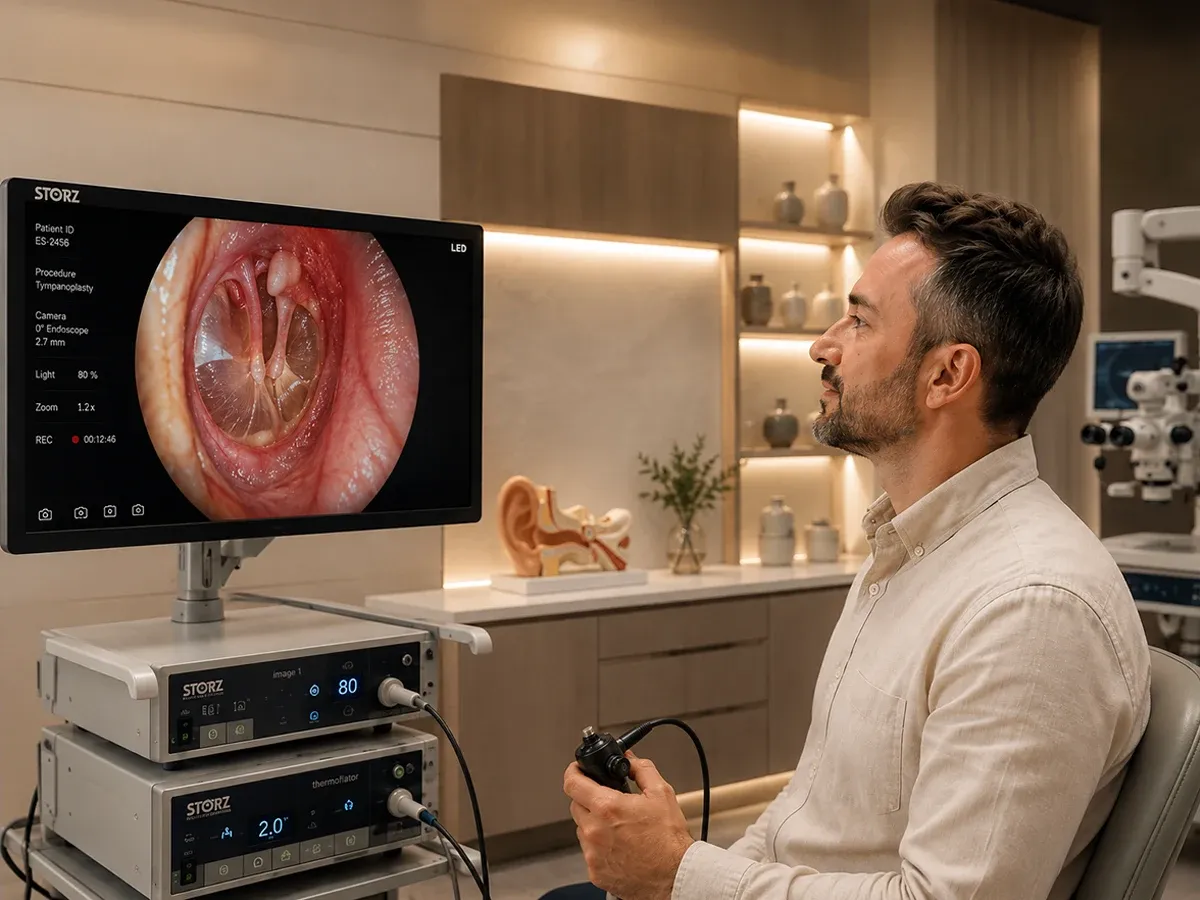
- Tympanoplasty: The general term for surgeries performed to reconstruct damaged auditory ossicles and/or the eardrum. According to its scope:
- Myringoplasty: Repair of only the eardrum.
- Ossiculoplasty: Repair of the ossicular chain along with the eardrum.
- Stapedectomy: In the treatment of otosclerosis (ossicular hardening), it is the procedure of removing the hardened stapes bone and replacing it with a prosthesis.
- Placement of a ventilation tube (tympanostomy tube): In cases of recurrent or persistent middle ear fluid (effusion) despite 3 months of medical treatment, a small tube is placed in the eardrum to drain the fluid and balance the pressure.
Implantable hearing equipment
These are alternative options for patients who are not benefiting from middle ear reconstruction surgery or present severe hearing loss.
- Bone-anchored hearing aids: They function on the principle of bone conduction. The implant is screwed into the skull bone and transmits sound vibrations directly to the inner ear. It is especially useful for conductive and mixed hearing losses when bone conduction is not severely impaired.
- Cochlear implant: An electronic device that bypasses the damaged hair cells in the cochlea (inner ear) and stimulates the auditory nerve directly. It is used in patients with severe and profound sensorineural hearing loss who do not benefit from conventional hearing aids. The operation normally lasts between two and three hours and is carried out under a general anaesthetic.
Assistive listening devices and hearing aids
They are the main mode of treatment of sensorineural hearing loss, which cannot be corrected by medical or surgical treatment.
Hearing aids:
They are programmed by an audiologist, based on the degree of loss and the individual’s needs. The intention is to improve intelligibility by separating speech signals from background noise.
Assistive listening devices (ALD):
They can be used with hearing aids or instead of hearing aids. They move the sound closer to its source to minimise the impact of distance, noise and echo. Examples:
- FM Systems (classrooms, meeting rooms)
- TV Listening Device
- Improved Telephones
Signal and alert systems:
Devices that convert sounds, such as doorbells, telephones or fire alarms, to visual/tactile stimuli, such as flashing lights or vibrations.
Hearing rehabilitation and training
Hearing aids or implants do not restore hearing fully. Hence, the rehabilitation process is an essential part of the treatment.
- Audiological rehabilitation: Aims to teach the individual how to maximise their residual hearing, develop communication strategies and adapt to their environment.
- Auditory training: Exercises to help the brain to better process sounds and discriminate speech. They are studying therapies that can be done at home.
- Training in communication strategies: Practical tips are taught to the individual and their family, such as facing the speaker, reducing background noise and asking for sentences to be repeated.
Lives saved by prevention and early diagnosis
The greatest enemy in diseases of the ear is delay. The golden window for treatment of sudden hearing loss is the first 48 to 72 hours. Wearing ear protection in a noisy environment, not cleaning your ears with cotton swabs and especially taking an annual hearing test after age 40 can help you detect diseases at an earlier stage.