
What Is Paediatric ENT?
Paediatric ENT is the specialist care of ear, nose and throat problems in babies, children and teenagers. It is a distinct field rather than adult ENT delivered to smaller patients, because a child’s ears, nose, throat and airway are still growing, and the way conditions behave in childhood is often very different from the way they behave in adults.
This distinction matters for parents. The symptoms that lead a family to an ENT clinic—poor hearing, mouth breathing, snoring, repeated sore throats, persistent nasal congestion—seldom exist on their own. They can influence how well a child sleeps, how clearly they hear speech, how confidently they speak, how well they concentrate at school and, in some cases, how they grow and develop. A paediatric ENT assessment therefore looks at the whole picture: not only what is happening in the ears, nose and throat, but also how it may be affecting your child’s daily life, learning and wellbeing.
What Are Common ENT Conditions in Children?
Recurrent Ear Infections
Middle ear infections, known medically as acute otitis media, are one of the most frequent reasons young children see a doctor. They typically cause ear pain, fever, irritability and disturbed sleep, and they are especially common between the ages of six months and three years.
Most episodes settle within about three days without antibiotics. The concern arises when infections return repeatedly or when fluid remains behind the eardrum between episodes. Recurrent ear infections can affect hearing during a critical window for speech and language development, so it is usually the pattern and frequency of episodes — rather than a single illness — that determines whether a specialist opinion is worthwhile.
Glue Ear and Hearing Difficulties
Glue ear, or otitis media with effusion, is the presence of sticky fluid in the middle ear without an active infection. It is extremely common in early childhood and often causes no pain at all. Instead, parents may notice that their child seems to ignore them, turns the television up, struggles to follow instructions in noisy surroundings, or appears tired and inattentive at school.
In many children, glue ear clears by itself over weeks or months. When it persists, however, it can cause a lasting reduction in hearing that may affect speech, language and concentration. Assessment usually involves a hearing test and tympanometry, which measures how well the eardrum moves. A period of monitoring is often advised before any surgery is considered, because the condition frequently improves with time.
Recurrent Tonsillitis and Enlarged Tonsils
Some children have repeated attacks of tonsillitis with sore throat, fever, difficulty in swallowing and time off school. Some people have enlarged tonsils that do not cause infection but do narrow the throat, resulting in snoring and interrupted breathing at night.
In recurrent tonsillitis, the frequency and severity of episodes, how many in a year, how much school is missed, and how often antibiotics are needed help guide whether specialist treatment is appropriate. Tonsil size is only judged in relation to sleep, breathing and swallowing function, because some children with large tonsils have no symptoms at all.
Enlarged Adenoids and Mouth Breathing
The adenoids are a pad of tissue at the back of the nose, which is largest in early childhood and slowly shrinks as a child grows. When increased in size, they block the flow of air through the nose. The result is mouth breathing, a permanently blocked nose, a nasal voice and disturbed sleep.
Moderate enlargement is often treated with observation and avoidance of exposure to tobacco smoke that irritates the airway and can worsen symptoms. Adenoid tissue often shrinks in size with age, so many children will improve without any intervention. In cases of significant and persistent symptoms, removal of the adenoids can be considered.
Snoring and Obstructive Sleep Apnoea
Snoring is common in children and is benign in many cases. If your child has pauses in their breathing, gasping, restless sleep, night sweats, or odd sleeping positions, such as sleeping with an extended neck, it’s a problem. Symptoms during the day can include irritability, difficulty concentrating, morning headaches, and in some children, behaviour problems that resemble attention difficulties.
Obstructive sleep apnoea is seen in approximately 1-4% of children and is most commonly related to enlarged tonsils and adenoids. Poor sleep can affect growth, behaviour and learning and persistent snoring with any of these features merits proper assessment rather than being dismissed as harmless.
Persistent Nasal Blockage and Allergic Rhinitis
Allergic rhinitis causes constant nasal congestion, sneezing, itching and a clear runny nose. In children it is often seen with asthma and eczema and can lead to mouth breathing, disturbed sleep and poor concentration.
Mild to moderate symptoms are often initially treated with antihistamines. Intranasal corticosteroids may be suggested for more persistent symptoms. The treatment in children is approached more cautiously than in adults, and the correct dose, technique and duration of use are important. Important also is to identify and reduce exposure to triggers like dust mites, pollen, and pet dander.
Recurrent Nosebleeds
Nosebleeds in children are usually caused by bleeding from small vessels in the front of the nose, often caused by dry air, picking, colds or allergies. Most can be treated at home with basic first aid by sitting upright, leaning forward and pinching the soft part of the nose for ten to fifteen minutes.
If your child has nosebleeds often, they are hard to control, or your child is younger than 2 years old, it is best to see a specialist. If a specific bleeding point is seen at the front of the nose, cautery is a common and effective treatment option. If a case is unusual or worrisome, further investigation is done to seek underlying causes.
When Should Your Child See an ENT Specialist?
Not every earache, sniffle or sore throat needs a specialist. Many childhood ENT problems settle on their own or with simple treatment from a general practitioner (GP). A referral becomes sensible when symptoms are persistent, recurrent or affecting your child’s development and daily life.
Consider arranging a paediatric ENT assessment if your child:
- Has hearing difficulties that seem to be affecting speech, language or school performance
- Suffers from repeated ear infections despite appropriate primary care treatment
- Snores, and especially if there are pauses in breathing, gasping or restless sleep
- Has recurrent tonsillitis that disrupts school, eating or sleep
- Breathes through the mouth much of the time, or has a persistently blocked nose
- Has nosebleeds that are frequent, heavy or hard to stop
- Has any of these symptoms alongside poor growth, daytime tiredness or behavioural change
When in doubt, it is reasonable to seek an opinion. A specialist assessment can often reassure parents that no treatment is needed, which is just as valuable as identifying a problem that requires intervention.
What Happens at a Children’s ENT Appointment in Antalya?
Discussing Your Child’s Symptoms and Medical History
The appointment starts with a conversation. We’ll ask about your child’s symptoms, how long they’ve been happening, how often they happen and what seems to make them better or worse. It is helpful to know about any previous treatments such as antibiotics, nasal sprays or hearing tests and if any close relatives have similar problems.
If you have any medical records, GP letters, hearing test results or imaging, please bring them with you. For example, if your family is coming from the UK, a written summary from your GP or local ENT service can be very helpful. It’s also worth making a note of your key concerns in advance – parents often find that having a short list helps to ensure nothing important gets missed.
Examining the Ears, Nose and Throat
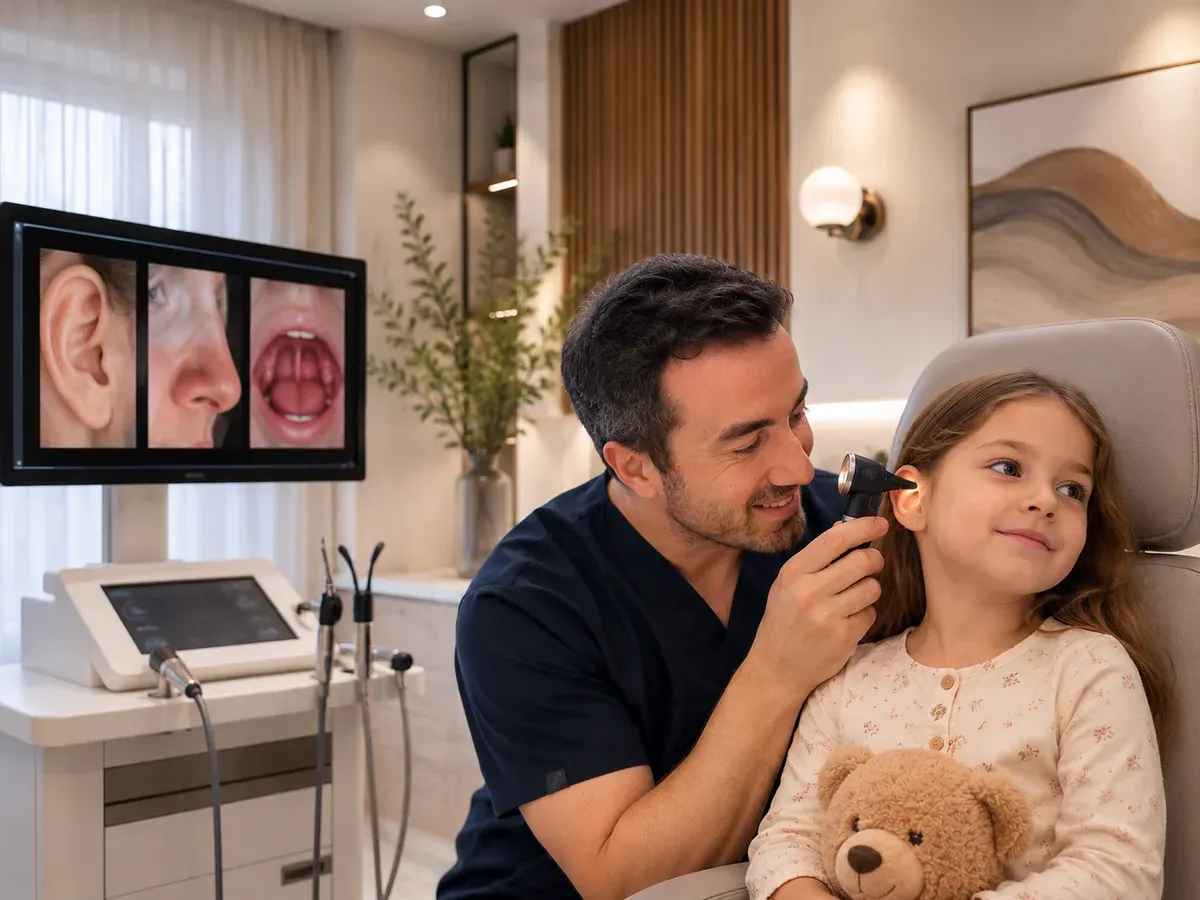
The exam is done gently and at the pace of your child. Younger children can sit on a parent’s lap, and the approach is adapted to make the experience as calm and comfortable as possible.
Examination usually involves otoscopy to view the eardrums, inspection of the nose and back of the throat, and assessment of the tonsils. Sometimes a small flexible endoscope can be used to get a clearer view of the adenoids and the upper airway. This is a quick procedure and is usually well tolerated by children when explained well.
Hearing Tests and Further Investigations
Depending on the symptoms, a hearing test and tympanometry may be organised. They are painless and give objective information about hearing levels and middle ear function, especially if glue ear or recurrent infections are suspected.
If sleep-disordered breathing is a concern, then further assessment (e.g., overnight oximetry or sleep study) may be discussed. Blood tests or allergy testing are only done if there is a specific reason for them and not as part of every assessment.
Recovery and Follow-Up After Paediatric ENT Treatment
It is worth remembering that many paediatric ENT conditions are treated without any surgery at all. Allergic rhinitis, mild glue ear, occasional nosebleeds and mild adenoid enlargement are generally managed by medication, observation and simple lifestyle measures.
When surgery is indicated, e.g., grommet insertion, adenoidectomy or tonsillectomy, the recovery period in children is usually short, and most children are back to normal activities within a week or so depending on the procedure. Pain relief is simple and discussed thoroughly beforehand.
Follow-up arrangements are based on what has been done and how your child is progressing. A clear written summary of the assessment, diagnosis and treatment plan can be provided to families to share with your GP or local ENT specialist, ensuring care continues smoothly after you travel home.
Planning Your Child’s ENT Treatment in Antalya
If you are thinking of paediatric ENT care in Antalya, the process will usually begin with a full assessment to find out exactly what is happening with your child’s ears, nose or throat. You’ll then be able to discuss treatment options, including non-surgical options, openly and have the time to ask questions and consider what’s best for your child.
If you’re an international family, appointments and any follow-up can be scheduled to fit your travel plans. Antalya is accessible by direct flights from many countries, including the UK, and many families find a short stay combined with a specialist assessment practical and reassuring. The key is to make decisions carefully, at the right pace for your child.